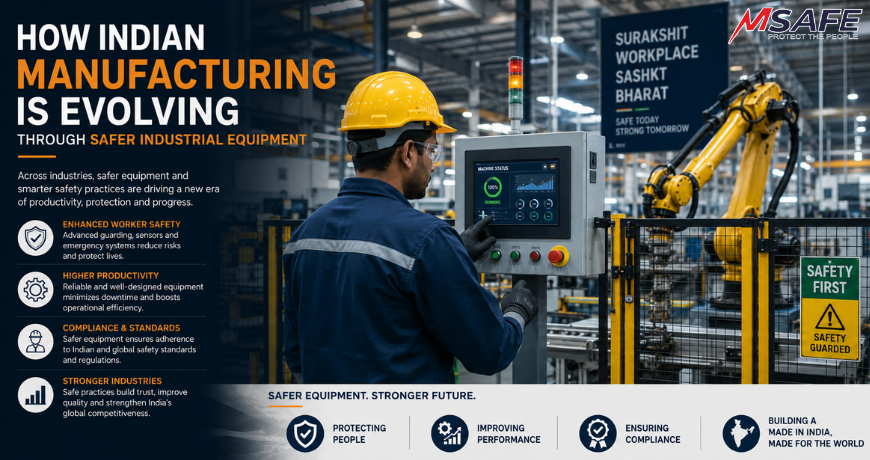
Introduction: A New Era for Indian Manufacturing
India is no longer just the world's factory floor — it is becoming the world's safest factory floor.
Over the past decade, Indian manufacturing has undergone a seismic shift. Driven by government mandates, global supply chain demands, and a growing awareness of worker well-being, industries across the country are replacing outdated machinery with safer, smarter, and more efficient industrial equipment. From automotive plants in Pune to chemical corridors in Gujarat, the emphasis on industrial safety is rewriting the rules of production.
At the heart of this evolution stands a critical question: How do you grow faster without putting people at risk?
The answer lies in the equipment you choose — and the standards you commit to.
The State of Indian Manufacturing: Where We Are Today
India's manufacturing sector contributes approximately 17% to the nation's GDP and employs over 60 million workers. With initiatives like Make in India, PLI (Production-Linked Incentive) schemes, and the ambition to become a global export hub, the sector is scaling at unprecedented speed.
But rapid growth without proportional investment in safety creates dangerous gaps.
According to industry data, workplace accidents in manufacturing cost India billions annually — in medical expenses, lost productivity, legal liability, and reputational damage. The solution is not to slow down growth. The solution is to build safety into the very foundation of manufacturing infrastructure.
This is where modern industrial safety equipment becomes a game-changer.
Why Industrial Safety Equipment Is No Longer Optional
1. Regulatory Pressure Is Increasing
The Factories Act, BIS standards, and India's alignment with ISO 45001 (Occupational Health & Safety Management) are tightening compliance requirements every year. Companies that fail to meet safety benchmarks face penalties, shutdowns, and exclusion from global supply chains.
Manufacturers exporting to Europe, the US, or Japan must now meet international safety standards — and that demands equipment built to those same standards.
2. Global Buyers Demand Safer Suppliers
Multinational companies conducting supplier audits scrutinize safety practices on the shop floor. A single accident or non-compliance report can cost a manufacturer its most valuable international contract. Investing in certified industrial safety equipment is no longer an operational choice — it's a commercial necessity.
3. Workforce Expectations Are Shifting
India's manufacturing workforce is younger, more aware, and more empowered than ever before. Workers are demanding safer environments, and companies that prioritize safety are seeing measurable improvements in retention, morale, and productivity. A safer workplace is a more productive one.
Key Categories of Safer Industrial Equipment Driving the Transformation
Personal Protective Equipment (PPE): The First Line of Defence
Modern PPE has come a long way from basic helmets and gloves. Today, manufacturers in India are adopting:
Smart helmets with built-in communication systems and impact sensors
Arc-flash rated clothing for electrical environments
Chemical-resistant gloves and suits with improved dexterity
Anti-fatigue footwear designed for long shifts on hard floors
High-quality PPE sourced from trusted suppliers reduces injury rates dramatically — and signals to workers that their safety is a priority.
Machine Guarding Systems: Preventing the Preventable
Unguarded machinery remains one of the top causes of industrial accidents in India. The shift toward interlocked safety guards, light curtains, and proximity sensors is dramatically reducing incidents in pressing, cutting, and assembly operations.
Modern machine guarding doesn't just protect — it also minimizes downtime by allowing safer maintenance access without full machine shutdowns.
Fall Protection Equipment: Working at Height, Safely
India's booming construction, warehousing, and high-bay manufacturing sectors are driving demand for advanced fall protection systems. These include:
Full-body harnesses with shock-absorbing lanyards
Self-retracting lifelines (SRLs)
Horizontal lifeline systems for elevated work platforms
Safety nets and anchor points for roof and structure work
Falls remain one of the leading causes of fatal workplace injuries globally. The right fall protection equipment, properly maintained and certified, is a life-saving investment.
Hazardous Area Equipment: Safety in Extreme Environments
Industries like oil & gas, chemicals, pharmaceuticals, and paint manufacturing operate in environments where flammable gases, dusts, or vapors are present. ATEX-certified and IECEx-compliant equipment — including explosion-proof electrical systems, intrinsically safe tools, and flame-resistant storage — is becoming standard practice.
The cost of ignoring hazardous area safety? A single explosion can devastate an entire plant, its workforce, and its surrounding community.
Fire Safety Systems: Beyond the Basic Extinguisher
Smart fire detection, suppression, and evacuation systems are replacing outdated setups across Indian factories. Addressable fire alarm systems, automatic sprinklers, deluge systems for high-risk zones, and emergency lighting with battery backup are becoming essential fixtures in modern manufacturing facilities.
Ergonomic Equipment: Protecting Long-Term Health
Musculoskeletal disorders (MSDs) from repetitive strain and poor posture are a growing concern in Indian manufacturing. Ergonomically designed workstations, adjustable platforms, lift-assist devices, and anti-vibration tool handles are helping manufacturers reduce absenteeism and long-term health costs.
The Role of Technology in Industrial Safety Evolution
The integration of technology with safety equipment is perhaps the most exciting frontier in Indian manufacturing today.
IoT-Connected Safety Devices
Wearable sensors can monitor workers' heart rate, posture, temperature exposure, and gas detection in real time — sending alerts before a situation becomes an emergency. Connected safety ecosystems allow safety managers to monitor multiple sites from a single dashboard.
Predictive Maintenance for Safety-Critical Equipment
Machine learning algorithms can now predict when safety-critical equipment — like pressure relief valves, conveyor guards, or lifting systems — is likely to fail. This shifts maintenance from reactive to proactive, preventing accidents before they occur.
Digital Training and Simulation
Augmented Reality (AR) and Virtual Reality (VR) training platforms are helping manufacturers in India train workers on hazard identification and emergency response — without exposing them to real risk. Digital safety training is more consistent, trackable, and scalable than traditional methods.
Make in India + Safety in India: A Powerful Combination
The Make in India initiative has accelerated domestic manufacturing capability — and has opened the door for Indian companies to not just consume safety equipment, but to manufacture and innovate within the safety sector itself.
India's safety equipment market is growing rapidly, with increasing demand for locally manufactured, internationally certified products. This creates an enormous opportunity for Indian manufacturers to supply both domestic industries and global markets with high-quality safety solutions.
Companies like Msafe Group are at the forefront of this movement — combining deep industry knowledge with a commitment to delivering safety solutions that meet the highest international standards while addressing the specific needs of Indian manufacturing environments.
How Msafe Group Is Powering India's Safer Manufacturing Journey
Msafe Group has built its reputation on one core belief: every worker deserves to go home safe.
With a comprehensive portfolio spanning PPE, fall protection, fire safety, hazardous area solutions, and industrial safety systems, Msafe Group serves industries across India — from manufacturing and construction to oil & gas, power, and infrastructure.
What sets Msafe Group apart:
Internationally certified products meeting IS, EN, ANSI, and NFPA standards
Expert safety consultancy to help businesses assess risk and design safer workplaces
Customized safety solutions tailored to the specific challenges of each industry
Reliable supply chains ensuring safety equipment is available when and where it's needed most
As Indian manufacturing scales to meet global demand, Msafe Group scales with it — ensuring that growth and safety always go hand in hand.
The Business Case for Safer Industrial Equipment
Still viewing safety as a cost centre? Here's why the math is actually the other way around:
A safer workplace is not just a moral obligation — it is a strategic business advantage. |
What the Future Holds: Indian Manufacturing in 2030
The trajectory is clear. By 2030, Indian manufacturing will be defined not just by volume and value — but by the safety culture embedded in every process and facility.
We can expect to see:
Mandatory IoT-based safety monitoring in high-risk industries
AI-driven risk assessment platforms integrated with factory management systems
Greater standardization of safety certifications aligning India with global benchmarks
A booming domestic safety equipment manufacturing sector competing globally
Zero-accident targets becoming standard KPIs for top Indian manufacturers
The manufacturers who invest in safety today are not just protecting their workers — they are building the resilient, globally competitive businesses of tomorrow.
Conclusion: Safety Is the New Competitive Edge
Indian manufacturing's evolution is not just a story of scale — it is a story of standards. As the country cements its place in the global industrial order, the commitment to safer industrial equipment, better practices, and a culture of zero harm is what will separate the leaders from the laggards.
Whether you are running a large-scale factory or a mid-sized production facility, the question is not whether you can afford to invest in safety. The question is whether you can afford not to.
Partner with Msafe Group and be part of India's safer manufacturing future.